
The material yoke is the castellan of the mundane appentencies. These desires can be recapitulated depending on three classes of animalian development: lower, middle, and upper. The former two classes exclusively demonstrate the Lesser Order of Appetencies, while the latter class introduces the Greater Order of Appetencies.
While animalia are complex and seemingly have a multitude of needs or interests, the whole of their appetencies can be summarized by the two Orders and all behaviors explained therein.
Classis Inferior
This class is the lowest of the three and includes the least-complex multicellular eukaryotic animalia. Their recapitulated appetencies include 1. Creation and 2. Self-Persistence. Neither are begotten from each other, only from instinct. Instinct begets the appetencies of Creation and Self-Persistence exclusively. Organisms in this class act almost mechanically as they survive and produce offspring.
Classis Media
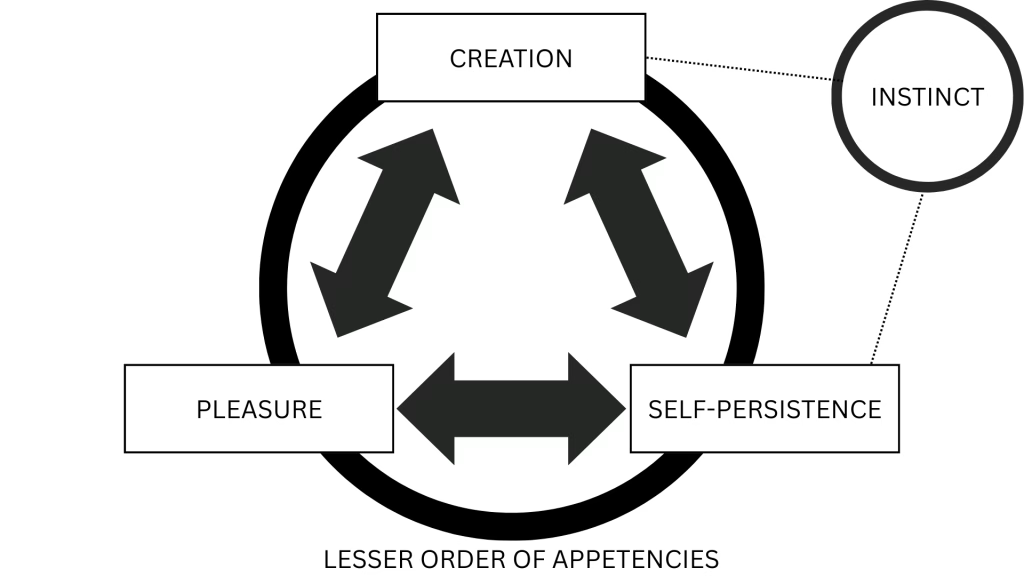
This class is in the middle of the three, and includes multicellular eukaryotic animalia with more complex nervous systems. Their core appetencies are the same as before, with the addition of the appetence of 3.) Pleasure. In Classis Media, the desires may be begotten from each other mutually. The original appetencies of Creation and Self-Persistance are still begotten from instinct as in Classis Inferior, but this is not true for Pleasure. Pleasure is a biological mechanism that encourages the instinctual appetencies of Creation and Self-Persistence. The addition of this appetence places a heavy burden on these animals as they now require more attention to their needs than an organism in Classis Inferior might need. The organisms in this class no longer behave mechanically like the previous class, rather exhibits behaviors that are encouraged or driven by pleasure; there is an introduced abstract element in the “why” to their creation and survival.
Classis Superior
This class introduces the Greater Order of Appetencies, which is similar to the Lesser except with the addition of the appetence of Knowledge. Humans are the most prominent creatures in this class. The Lesser Appetencies may be begotten from each other mutually, while the appetencies of Creation and Self-Persistence are also begotten from instinct. The addition of Knowledge introduces more appetential relationships. Now, there is a mutual relationship between Knowledge and each point in the Lesser Order.
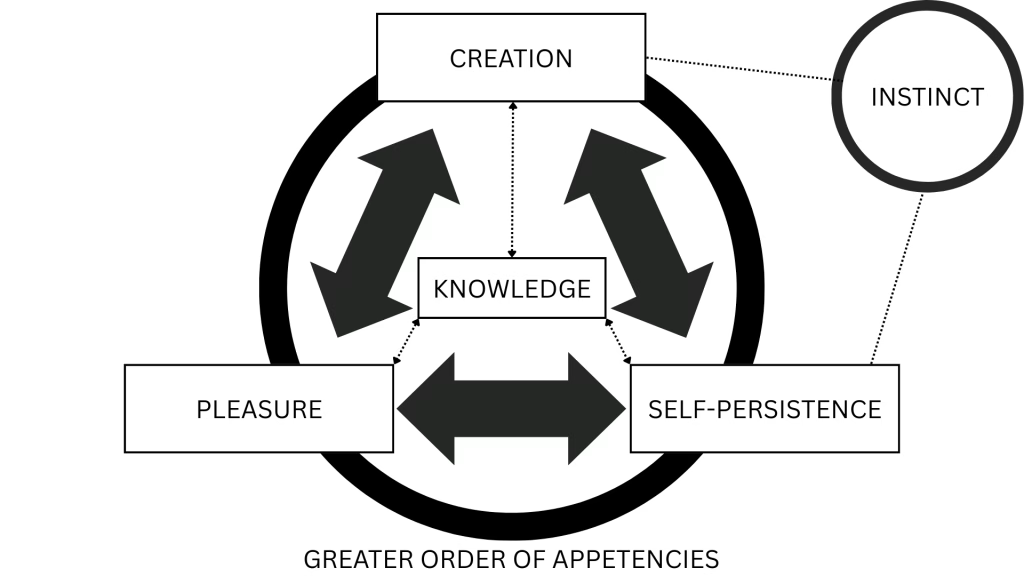
The introduction of Knowledge also heralds the spirital nature of the appetencies. I’ve chosen the antiquated “spirital” to simply mean incorporeal, not necessarily in relation to the concept of a spirit or soul. Now there is a pleasure that can be obtained through knowledge, and creation that can be begotten from knowledge, and survival can be gained through knowledge. Knowledge may be fulfilled without physical manifestation. Almost paradoxically, self-persistance can be achieved with a spirital (incorporeal) approach because of the knowledge that the mundane will persist after departing the mortal coil. An example of this bifurcated fulfillment is that human beings constantly struggle to stay alive, and upon passing, will thereafter venerate the dead with tombstones and memorials so that the memory of the dead may persist.
This is not to say that humans are the only organisms capable of mourning, but that organisms in Classis Superior sometimes possess a foreknowledge of their demise and can fulfill the appetence of Self-Persistence using an incorporeal approach.
This is also not to say that organisms in the two other classes don’t learn. They do learn, and there is evidence that even jellyfish – with their nervous-net bodies – learn about their surroundings to avoid obstacles. However, only organisms in Classis Superior exhibit behaviors that demonstrate the appetence of knowledge. This includes the desire to learn about our environments, not merely as a reaction to stimuli, but also as an anticipation of a potential benefit. Us humans, for example, study other animals, each other, how we communicate, how our bodies work, et cetera; using this knowledge, we are able to create in ways material & spirital, self-persist, and please.
There is no evolutionary advantage to being an artist, or a businessperson, or a flight attendant, or any exact profession, office, or station. I believe this is done to some degree of a mix of the appetencies; the violinist is pleased to learn violin, creates compositions or assists in the production thereof, and self-persists by the assistance of their profession.
To focus solely on the material nature of the appetencies is to deny the individual of the spirital/incorporeal nature which also exists, and vice versa. Fulfilling the desires materially is the default to the Lesser Order, and must be the easier choice since our consciences are well-tethered to the mundane. To be fulfilled incorporeally means to create without producing off-spring, to seek persistence without the express purpose of immediate survival, and to be pleased without physical sensation. This is more difficult, since we cannot escape the material yoke fully without death.
The marriage between the cosmic soup of our consciousness and material manifestation reminds ourselves and others of our nature as humans. Art is the bridge between the seen and the unseen; it is the arrow that points to release of the yoke, considered periodically, while only actualized upon death.