
- Is the Human Mechanism Apeirochoronic?
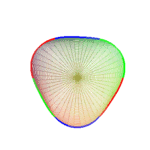 I’ve proposed polychoronic dispersion as an illustration of personhood in a previous post, which you can find here. Individuality is informed by an individual’s polychoronic rotation, which include a multitude of seemingly finite facets. Finite is the distinction that suggests personhood is expressed via a choronic rotation that is not infinite. Paradoxically, I do not… Read more: Is the Human Mechanism Apeirochoronic?
 - Polychoronic Dispersion and the Persistence of Self
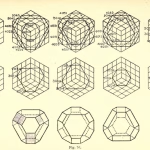 The expression of personhood is analogous to the rotation of a hyperdimensional polytope. The “self” is not linear or ontologically static, but rather expressed in a multidimensional geometry that is fleetingly revealed in fragments.
 - Supergolden Craniofacial AnthropometryIn our contemporary society, when you hear of an individual experiencing an emotional response to art, the typical first expectations of the medium are that of music, film, prose, poetry, and sometimes visual art (among others). Media which are bound by the very nature of their respective definitions to be experienced utilizing a temporal element will induce emotional resonance more frequently than those that do not.
- Temporal Experience and Emotional Resonance with ArtIn our contemporary society, when you hear of an individual experiencing an emotional response to art, the typical first expectations of the medium are that of music, film, prose, poetry, and sometimes visual art (among others). Media which are bound by the very nature of their respective definitions to be experienced utilizing a temporal element will induce emotional resonance more frequently than those that do not.
- Ordines Appetentales
 The material yoke is the castellan of the mundane appentencies. These desires can be recapitulated depending on three classes of animalian development: lower, middle, and upper. The former two classes exclusively demonstrate the Lesser Order of Appetencies, while the latter class introduces the Greater Order of Appetencies. While animalia are complex and seemingly have a… Read more: Ordines Appetentales