
As I explore the supergolden mean (\psi) in my latest series of works, I’m discovering new ways that the metallic ratio can manifest. Since the golden mean (\phi) can be used in craniofacial anthropometry, I thought it may be interesting to project a hypothetical anthropometry based off the supergolden mean.
The supergolden ratio is the positive solution to the equation x^3 = x^2 + 1. Being a cubic equation, the ratio has three degrees of self-similarity (compared to the golden ratio’s two degrees).
“It was reported that the golden ratio (i.e., 1.618) serves as a useful ratio for aesthetic facial proportions” (Armengou et al.). The research goes on to say “the facial length (i.e., distance between trichion and menton) should be 1.618 times longer than the facial width (i.e., distance between zygomas on both sides). The distance between the trichion and the most lateral point of the nostril (‘upper aspect of the face’) should ideally be 1.618 times as long as the distance between the most lateral point of the nostril and the menton (‘lower aspect of the face’)” (Armengou et al.).
Taking this and the nature of the supergolden ratio having three degrees of self-similarity, I’ve illustrated an analogous simulacrum of a mask using the researcher’s demonstrations (Fig. 1).
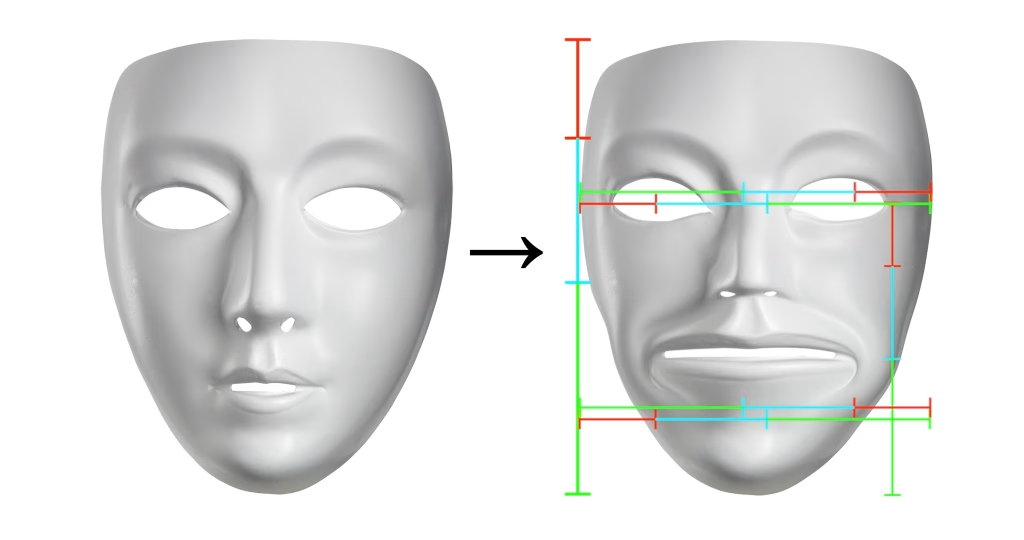
The result is still recognizable as a human face, but the features are much more exaggerated due to the cubic nature of the supergolden ratio. It appears almost androgynous with more exaggeration.

In my painting Supergolden Lorigal, I’ve utilized the analogous anthropometry in the composition with the figure of evil, or the sorcerer Elïavrés.
References
Armengou, Xavier, et al. “Facial Anthropometric Measurements and Principles – Overview and Implications for Aesthetic Treatments.” Facial Plastic Surgery, vol. 40, no. 3, 2024.