
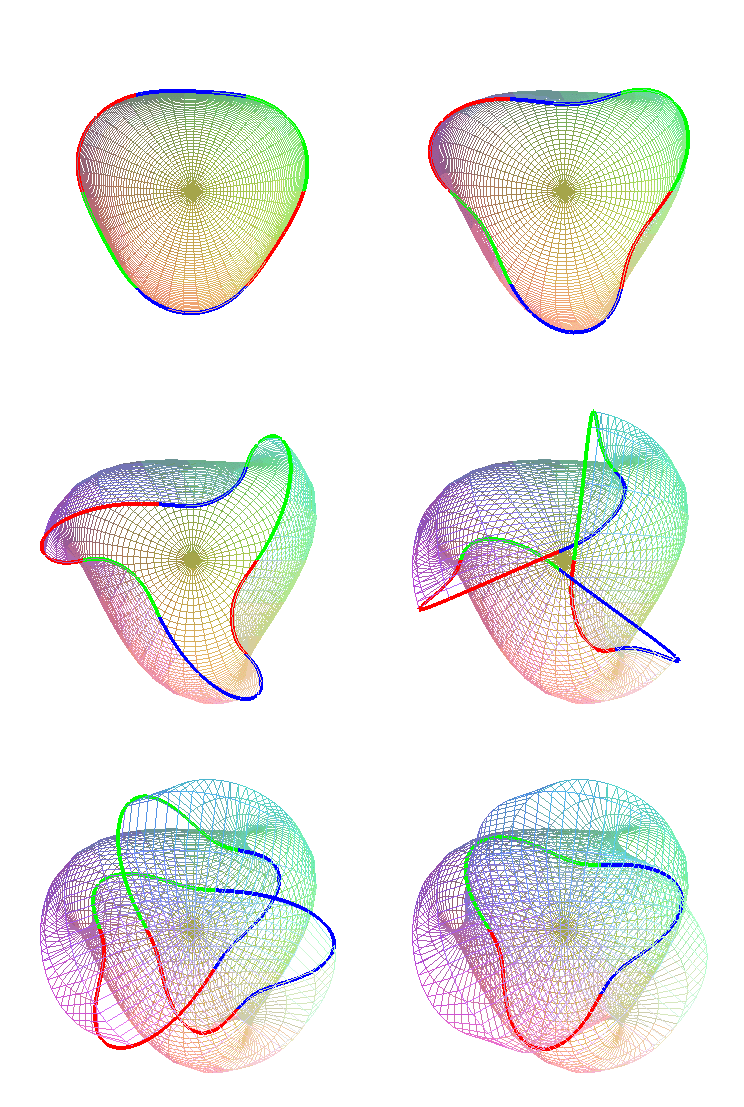
I’ve proposed polychoronic dispersion as an illustration of personhood in a previous post, which you can find here.
Individuality is informed by an individual’s polychoronic rotation, which include a multitude of seemingly finite facets. Finite is the distinction that suggests personhood is expressed via a choronic rotation that is not infinite. Paradoxically, I do not believe the facets of the finite polytope can be comprehensibly identified, although this is the aim of modern psychological research.
The existence of individuals who may be widely considered extreme does not suggest the human mechanism to be apeirochoronic. There are extreme individuals who exist within and without our modern historical record; individuals who are oft marginalized due to their extreme nature. It is easy, and perhaps antipathetic to regard these individuals as an expression of a mechanism which is other than our very own.
All individuals possess the capability of expressing the most extreme facets of the human mechanism. The existence of extremities in the machine does not mean that the extremities are unbecoming, rather it is prudent to be aware that the extremities may exist and can be formed anywhere, including within your own very expression.
The extremities are not merely lessons of an unreachable archetype. This is a product of antipathy. The extremities exist within you, a fellow expression of the homomechanan.
This is not to say that the extremities are necessarily dangerous or harmful either. Most people, I believe, submit their passions with an excess of tempering to their detriment. It is prudent to set bounds of tempering surrounding your passions, but not to outright harden the mercurial flames of passion till you are merely left with inaction and, in my opinion, definitive conformity. To be temperate within the golden mean bestows an individual with a more vibrant expression of the polychoronic mechanism that is human nature.
At its core, the human mechanism necessitates sustenance from its inheritors. This sustenance is frequently mistempered, which can limit the remaining expression of the human polychoron. Magnitude of homomechanic expression is bound by time and sustenance. Thus, when the two bounds are satisfied, more facets can be explored and expressed.